
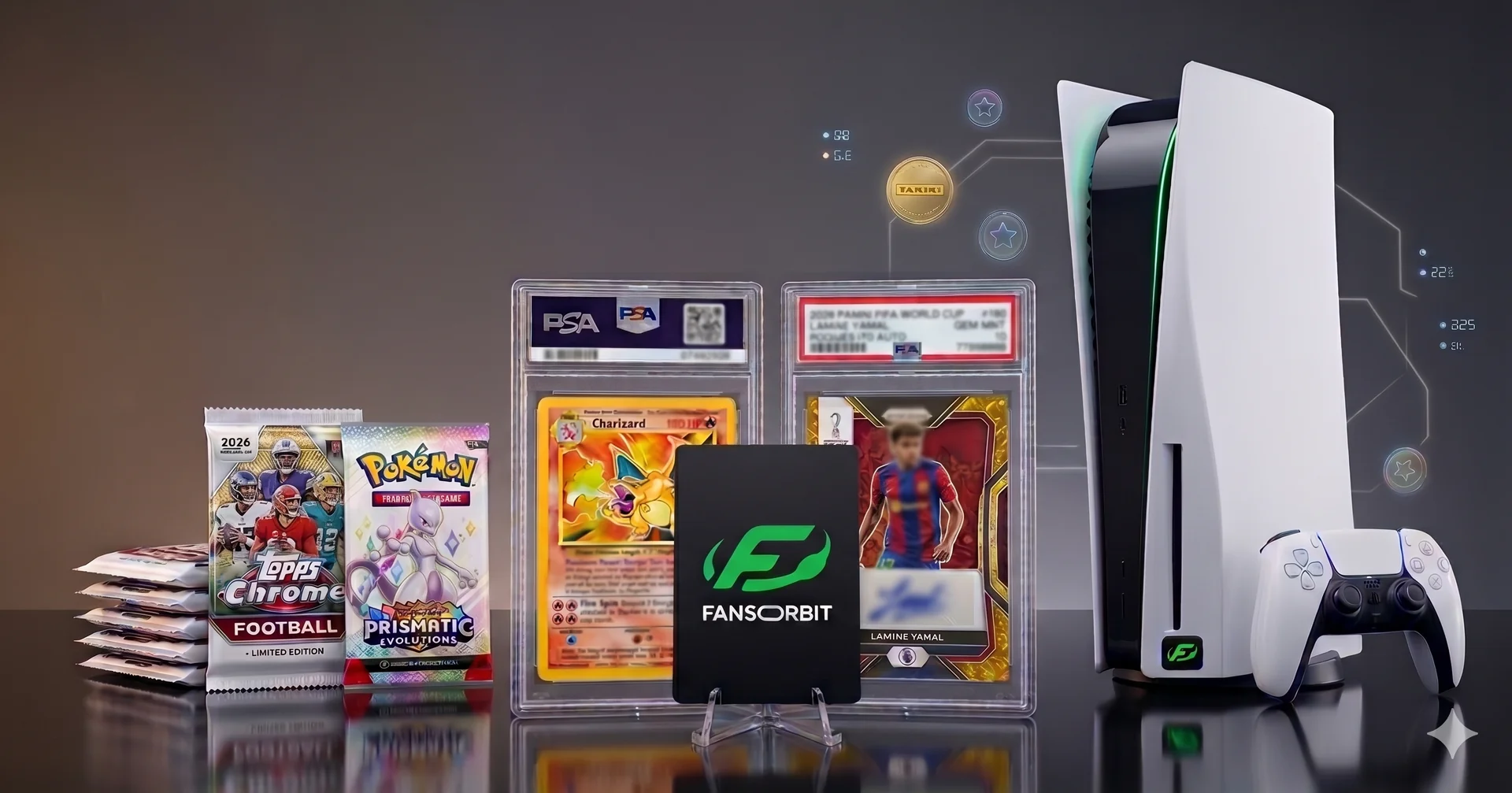
What began as a children's pastime in the playgrounds of the 1990s has mutated, in this 2026, into one of the most powerful alternative-asset industries in the world. Card collecting is no longer just a hobby; it's a financial ecosystem that moves more than $9.5 billion a year globally. Today, opening a pack of cards isn't just looking for your favourite player, it's, in many cases, making an asset opening with a revaluation potential that exceeds the stock market or cryptocurrencies.
In this report, we analyse why "cardboard" has become the new gold, the critical importance of professional grading and which Topps, Panini and Pokémon products are breaking every price and demand record.
1. The grading phenomenon: The difference between a card and a treasure
If there's one concept that has changed the rules of the game forever, it's Grading. In today's market, the physical condition of a card is everything. A "Raw" card (fresh out of the pack) is a promise, but a graded card is a financial reality.

What exactly is grading?
Grading consists of sending a card to internationally renowned certifying entities such as PSA (Professional Sports Authenticator), Beckett (BGS) or SGC. Experts analyse the card under microscopes and ultraviolet light, evaluating four critical points:
Centring: That the image is perfectly centred against the edges.
Corners: That they keep their 90-degree angle without the slightest wear.
Edges: The absence of nicks or "whitening" (white spots).
Surface: That there are no scratches, print marks or fingerprints.
The impact on value
The economic difference is huge. Let's take an emerging star's card as an example:
"Raw" condition (Ungraded): €30.
PSA 9 grade (Mint): €80.
PSA 10 grade (Gem Mint): €450 or more.
In 2026, grading has reached a level of sophistication where companies use advanced AI to detect imperfections invisible to the human eye. This has built total confidence in investors: when you buy a card with a "10" on the label, you know you have physical perfection encapsulated for eternity.
2. Football and sport: Topps vs. Panini, the war for the throne
The king of sports is the engine of collecting in Europe. In this 2026, the competition between the two giants of the sector has taken product quality to luxury levels.

Topps: The dominance of Chrome technology
Topps has known how to capitalise on its UEFA Champions League and Premier League licence through its Chrome line. These cards, manufactured with a metallic and shiny finish, are the favourites of mid- and high-end collectors.
Parallels and numbered cards: The hunt focuses on the "Refractors". Cards that, being the same image, have different colours according to their scarcity. The "Gold" parallels (numbered /50) or the "Red" ones (/5) are very valued trophies. But the Holy Grail is the Superfractor 1/1, a unique card in the world that can reach six-figure sums at auction.
Panini: The giant of the 2026 World Cup
Panini remains the king of nostalgia and the masses. With the 2026 World Cup being held this summer, its Adrenalyn XL collection has broken sales records. However, for the serious investor, Panini offers the Prizm and Donruss Optic lines. In NBA basketball and NFL football, a Panini "Rookie" card graded 10 is still the industry gold standard.
3. Pokémon TCG: Beyond nostalgia
If there's one product that doesn't know about crises, it's Pokémon. What many considered a passing fad 25 years ago is today the most liquid TCG (Trading Card Game) on the market.
The "Vintage" market
Cards from the 1990s (Base Set, Jungle, Fossil) have become safe-haven assets. Owning a 1st Edition graded Charizard is, in 2026, the equivalent of having a gold bar in the safe. Its price keeps rising because supply is limited and the demand from the millennial generation (now with high purchasing power) is insatiable.
The new collections: Miniature art
Modern expansions like "Prismatic Evolutions" have changed the approach. It's no longer just about the card's power in the game, but the beauty of the art. "Alternative Art" or "SAR" (Special Art Rare) cards are real miniature paintings. In 2026, Pokémon has collaborated with renowned contemporary artists to design cards that are exhibited in art galleries, blurring the line between toy and collector's work.
4. Disney Lorcana and One Piece: The new challengers
2026 has also consolidated two new players that have stolen market share from the classics:
Disney Lorcana: It has attracted a mass audience that didn't collect cards. The magic of Disney combined with a solid game system has made its "Enchanted" cards (the rarest) extremely hard to get and very valuable.
One Piece Card Game: The anime phenomenon has moved to cardboard with overwhelming success. Its cards with illustrations pulled straight from the manga are the favourite of the young public and its trading market is one of the fastest and most dynamic out there.
5. The future: Tokenisation and digitalisation
We're seeing how the physical and digital world are merging. In 2026, many high-value graded cards are kept in high-security "Vaults". The owner doesn't physically have the card, but a digital certificate (or NFT) representing ownership. This allows a €100,000 card to be sold in seconds on an online platform without needing to mail it, avoiding risks of loss or damage.

Win your PlayStation 5 to dominate gaming
We know that collecting and gaming are two sides of the same coin. Many of those looking for the Lamine Yamal or Kylian Mbappé card do so to then see them shine in their EA Sports FC 26 teams.
At FansOrbit, we want you to take that passion to the next level. That's why we have an active PlayStation 5 giveaway completely free for our community.
How to take part? It's very simple: sign up on the platform and stay active. Entering daily to interact with your favourite creators gives you automatic entries.
No tricks: You don't need to buy packs or pay subscriptions. We reward your loyalty and your consistency.
Imagine opening your physical Pokémon or Topps packs while in the background your new PS5 downloads the latest update for your favourite game. In our orbit, the big prize isn't only inside the cardboard packs; we also hand it out!
Conclusion
The world of Trading Cards in 2026 is exciting, complex and extremely lucrative for those who can read the market. Whether for the adrenaline of opening a pack, for the love of the art of a Pokémon card, or for the investment vision in a young football prospect, collecting is more alive than ever.
The key to success lies in information: knowing what to grade, when to buy and where to follow the trends. And remember, whatever happens with the market, the emotional value of a good collection is something no certifier will ever be able to grade.