
The truth is that we've all felt that frustration: entering a search engine, typing in a question and having to wade through ads, cookie-stuffed websites and filler paragraphs before finding the answer. That model, which ruled for decades, is dying. Using AI as a replacement for the traditional search engine on the internet is not a passing fad; it's a direct response to our need for efficiency. Now, instead of being librarians handing us a list of books, platforms have become oracles reading us the exact chapter we need.
This transition is not just changing how we search; it's redefining the entire business of visibility. For a content creator, the challenge is no longer just to "be there" but to be the source from which artificial intelligence draws its wisdom. Immediate-utility marketing is replacing the old interruption model. And let's be honest, once you get used to receiving a precise answer in three seconds, jumping from page to page again feels like using a paper map in the GPS era.
The shift in digital consumer psychology
Technology has irreversibly modified our patience threshold. We no longer just want "options"; today we want direct solutions. This psychological shift is the engine driving tools like Perplexity, ChatGPT or Gemini to the top of digital traffic. The audience no longer wants to be an active agent filtering information; they prefer to delegate that technical task to a system that processes the noise for them.
Conversational search: We no longer use isolated keywords; we talk to the machine as if it were an expert colleague. This shifts content strategy towards more natural language and less robot-friendly structuring.
Cutting out the noise: The user deeply values that AI filters intrusive advertising and low-quality content for them, delivering only the essence. "Banner blindness" has now moved to sponsored search results.
Infinite context: AI remembers what we asked before, allowing a much smoother learning experience. This creates a technological loyalty that the traditional search engine could never offer.
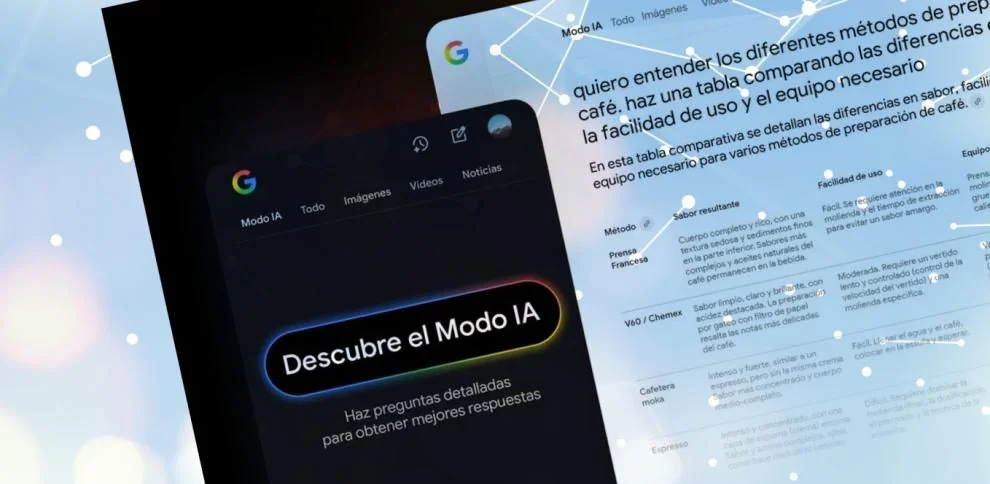
The impact on creators' business model
If users no longer click the ten blue links, what do websites live off? This is the million-pound question in the digital marketing world. The answer lies in business adaptation. We're moving from an economy based on click volume to an economy based on the source's authority and trust. The websites that survive will not be those drawing the most accidental traffic, but those that become indispensable knowledge nodes.
Strategies to stay on the map
For your content to stay relevant, the strategy must be radically more qualitative. AI needs reliable sources to avoid "hallucinating" or making up data. If you become that technical, truthful source, the response technology itself will cite you, granting you prestige no ad can ever buy.
Deeply specialised content: AI is excellent at generalities, but it usually fails in technical or very local niches. That's where your business has its greatest strength.
Personal brand building: People will search directly for your name if they know your analysis is unique. Community marketing is the best antidote to algorithmic invisibility.
Optimising for citation (GEO): Generative Engine Optimization (GEO) is the new frontier. Structuring data so that technology can easily "read" your conclusions raises the probability of being the answer that gets generated.
The technology behind the new data crawling
It's fascinating how crawler bots have evolved. They no longer just index words; they now try to understand human intent and semantic value. Natural language processing (NLP) technology lets these tools understand whether your article actually adds value or is just filler. The truth is this is excellent news for the ecosystem: the junk-content business has its days numbered.
Democratising complex information
One of the most human aspects of this change is how using AI as a replacement for the traditional search engine helps non-technical people understand complex topics. Before, researching a legal or financial process required reading dozens of dense articles. Now, AI acts as a translator of concepts, bringing knowledge down to a language anyone can access.
This opens a new niche of educational marketing. The businesses that make this learning easy through their data will be the ones to dominate the recommendations of the digital oracles. It's not just about informing, but about educating the technology so it educates the end user.
Marketing of transparency and ethics
In this new scenario, ethics becomes a fundamental marketing strategy. As we trust automated answers more, we also become more sceptical about the origin of that information. The businesses that show their processes and their human team generate a value difference the machine can't replicate.
Human verification: In a sea of synthetic responses, the "reviewed by an expert" stamp will be the new gold standard for any digital business.
Emotional connection: AI can inform you with surgical precision, but it cannot inspire you. Marketing that appeals to human values and lived experience will remain exclusive territory for people.

Conclusion: Towards a future of personalised answers
The business of the future won't be a one-size-fits-all list of results. Thanks to generative technology, the answer will be personalised to each individual's context, education level and preferences. This is personalisation marketing taken to its maximum expression.
Adapting to using AI as a replacement for the traditional search engine requires courage. It means putting vanity metrics, like total visit count, aside and starting to measure how many times we are the definitive answer to a problem. The truth is that change is scary because it breaks the rules we learned over the last twenty years, but it also clears the path of unnecessary middlemen.
For those of us in digital strategy, the goal is clear: stop writing for a ranking algorithm and start writing for a shared knowledge ecosystem. The traditional search engine taught us to find; AI is teaching us to understand. In this process, the business of human communication has a golden opportunity to recover its essence: to bring real, direct and meaningful value to people's lives.