

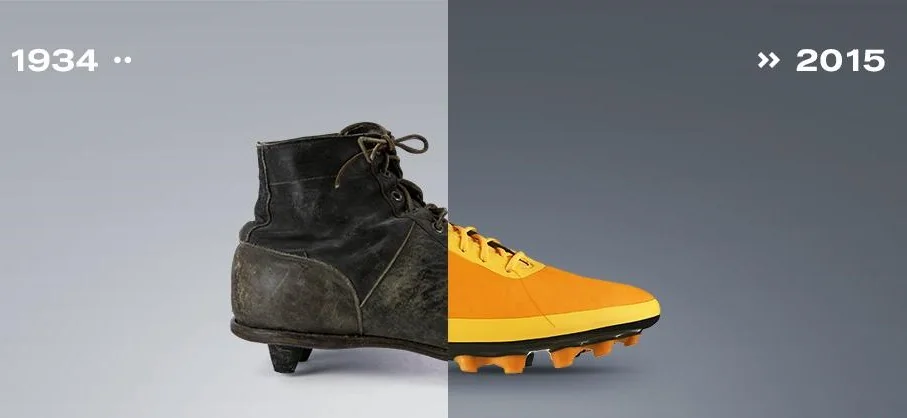
The truth is that, if a 1950s player travelled in time and saw today's footwear, he'd think he was looking at science-fiction props. The evolution of football boots isn't just a matter of aesthetics or passing fashions; it's the mirror of an industrial and technological strategy that has completely transformed the business of the world's most popular sport. What used to be heavy cowhide boots, designed almost like safety footwear to protect the foot, are today genuine extensions of the human body, designed in high-precision laboratories.
This radical change has allowed football to be faster, more technical and, above all, much more commercial. Brands no longer just sell a pair of shoes; they sell a promise of performance, a competitive edge based on materials technology. And in modern marketing, every gram shaved off a boot is a multi-million-pound sales argument the big firms exploit masterfully with every season's launch.
The leather era: when durability was everything
For decades, the evolution of football boots was stuck in a paradigm of robustness. Kangaroo leather was the gold standard for its flexibility, but the big problem was water.
The weight of the past: On rainy days, boots absorbed moisture and doubled their weight, hampering player agility.
Fixed wooden or leather studs: Before interchangeable-stud technology, grip was a matter of luck and pitch conditions.
Protection over touch: The toe cap was extremely rigid, prioritising safety against kicks over the sensitivity needed to caress the ball.
The synthetic-materials revolution and the featherweight
In the late nineties and early 2000s, the football business made a 180-degree turn. Brands understood that speed was the new differentiator in sports marketing. The evolution of football boots entered its most aggressive phase with the introduction of synthetic fibres and microfibres that allowed impossible colours and weights below 200 grams.
The impact of flyknit technology and the integrated sock
One of the most disruptive milestones of the last decade was the disappearance of seams. The introduction of knit fabric (known as knit) changed the manufacturing strategy forever.
360-degree fit: The boot stopped being a container for the foot and became a sock with a sole. This dramatically improved the "touch" on the ball.
Removing laces: Compression technology made it possible to create laceless models (laceless), offering a clean, pure striking surface — a dream come true for strikers.
Position-based personalisation: Today, marketing segments boots: some for midfield control, others for winger speed and others for striker power.
The business of exclusivity and limited editions
The evolution of football boots has stepped off the pitch to become an object of desire and collecting. Brands have skilfully applied a strategy of artificial scarcity to raise the value of their products. Launching "drops" or limited editions is a marketing tool that drives massive traffic to digital stores and keeps the community on tenterhooks.
Data and performance: the smart boot
Technology has not stopped at the surface. In the last few years, we've seen the integration of chips and sensors inside the sole to measure distances, top speeds and heat maps.
Big Data for the player: The business is now also about selling data. Players can sync their boots with their smartphone to analyse their performance after the match.
Carbon-fibre soles: Originally used in the aerospace industry, this technology provides explosive energy return with every stride, improving acceleration.
Sustainability: The new strategy from brands includes using plastics recycled from the oceans, aligning the business with modern consumer values.
The human factor: from idol to personalised boot
Despite all this technology, marketing still depends on the human factor. Seeing stars like Messi, Mbappé or Lamine Yamal debut an exclusive model is what really moves the sales needle. The evolution of football boots is intrinsically linked to the player's identity; they are no longer just tools, they are an extension of their personal brand.

The psychology of colour and design
The truth is that the colour of a boot can influence game perception. Neon tones aren't just to draw attention; they're a strategy so teammates (and spectators) can quickly identify the player's position on the pitch. This makes fast decision-making easier, proving that even aesthetics have a business and tactical-use base.
Conclusion: where the future of footwear is heading
In short, the evolution of football boots is testimony to how human ambition and technology can transform a basic tool into a masterpiece of engineering. We've gone from protecting our feet to enhancing our natural abilities to near-superhuman levels. The athletic footwear business will keep innovating, possibly towards personalised 3D printing tailored to each user's exact foot shape.
What's clear is that the strategy of the big brands will keep focusing on making us feel that, with the right pair of boots, anyone can reach glory. The truth is that, even though the boot doesn't make the player, today's technology lets them express their talent with no physical barrier. From yesterday's heavy leather to today's smart fabric, boots have travelled a fascinating path, reminding us that in football, like in marketing, standing still is the first step towards being out of the game.