

The truth is that convenience is a powerful drug. In barely a couple of years, we've gone from researching across various sources to dumping any doubt, however complex or personal, into the window of an artificial intelligence chat. This technology has given us the illusion of having a genie in a lamp available twenty-four hours a day. However, we're falling into a critical life strategy error: believing that AI is an infallible oracle. Asking AI everything isn't only a matter of efficiency; it's a surrender of our intellectual autonomy that can have disastrous consequences for our business and personal life.
From a marketing perspective, tech companies have sold us the idea that AI is the solution to analysis paralysis. But the truth is that, by outsourcing all our decisions, we are losing the "muscle" of our own judgement. AI doesn't know what's right; it only knows what's most probable according to its database. Trusting it blindly is like sailing a ship with a GPS that occasionally decides the desert is an ocean.
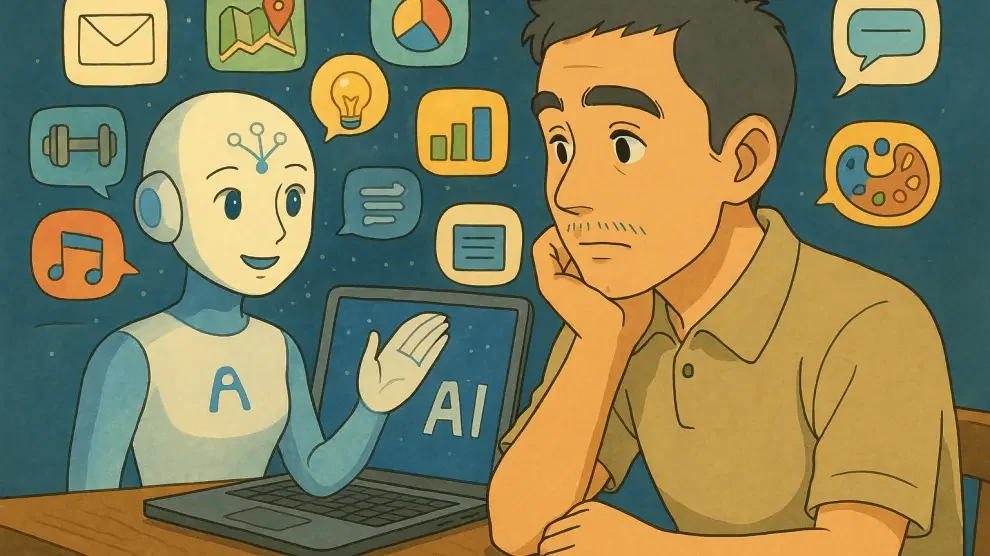
The instant-answer trap
AI's success lies in its ability to give us an answer in seconds. But in the decision-making business, fast is rarely best.
The death of serendipity: When we ask AI everything, we stop finding those unexpected solutions that emerge when we investigate on our own.
Algorithmic confirmation bias: AI tends to give us answers that fit how we ask, reinforcing our own prejudices instead of challenging them.
The end of cognitive effort: Without having to work hard to understand a problem, our ability to retain information and truly learn fades away.
The danger of hallucination in the professional world
One of the biggest strategy mistakes is using AI as a source of absolute truth on technical, legal or medical matters. Language-model technology is designed to be coherent, not necessarily truthful. That's what experts call "hallucinations": AI can invent laws, bibliographic citations or financial data with stunning confidence. In content marketing, for example, publishing erroneous AI-generated data can destroy a business's reputation in minutes.
The risk of homogenised mediocrity
If we all ask the same AI to design our marketing campaigns, write our emails or plan our business models, the result is grey uniformity.
Soulless content: AI recycles what already exists. If you rely on it to innovate, you'll always be one step behind the market.
Losing your own voice: In personal marketing, authenticity is the most valuable asset. An AI-written response is identifiable by its lack of nuance and human passion.
Emotional disconnection: Asking AI how to handle a human conflict (with an employee or a partner) takes empathy out of the equation, offering logical but often cruel or off-context solutions.
Technology as a co-pilot, not a captain
The mistake isn't using AI but how we use it. The smart strategy is to use this tool to speed up mechanical processes, but never to replace final judgement. In modern marketing, AI should draft the first version, but the human must bring the vision, the ethics and the real connection with the audience. The business of the future belongs to those who can orchestrate the machine's power with human sensitivity.
The human factor: what AI will never be able to query
There are corners of reality inaccessible to any algorithm. No matter how much technology we apply, there are factors AI simply can't process.
Experience-based intuition: That business "nose" you build over years of hits and misses.
Ethics and responsibility: An AI cannot be held responsible for the consequences of a decision; you can.
Subtle cultural context: Double meanings, irony and social sensitivities change faster than an AI can update itself.

How to avoid intellectual dependence on AI
To avoid the mistake of asking AI everything, we must establish a digital-hygiene strategy. It's vital to recover the habit of cross-checking information and, above all, of allowing ourselves to doubt.
The contrast rule: For every important AI query, look up at least two independent human or documentary sources.
Encourage lateral thinking: Before asking AI for an idea, force yourself to write ten ideas of your own. Use the machine only to polish, not to create from nothing.
Embrace the discomfort of doubt: The truth is that not knowing something straight away is the engine of learning. If AI gives us every answer, we'll stop asking the right questions.
Conclusion: The value of being "analogically" intelligent
All in all, artificial intelligence is the most powerful tool we have created, but its greatest danger is that it makes us lazy. The mistake of asking AI everything is, ultimately, a mistake of confidence in our own abilities. The business of life requires presence, risk and, sometimes, being wrong on our own.
The strategy for the future isn't to turn our back on technology, but to lead it. We must learn to ask, but also to doubt the answer. The truth is that AI can help you write an article, but it can't tell you what really matters to your heart or your community. Keeping our critical-analysis ability alive is the only way to make sure AI remains our tool and we don't become a by-product of its algorithm. In a world saturated with automatic answers, human intelligence — slow, imperfect and deep — is the most exclusive luxury we can cultivate.