
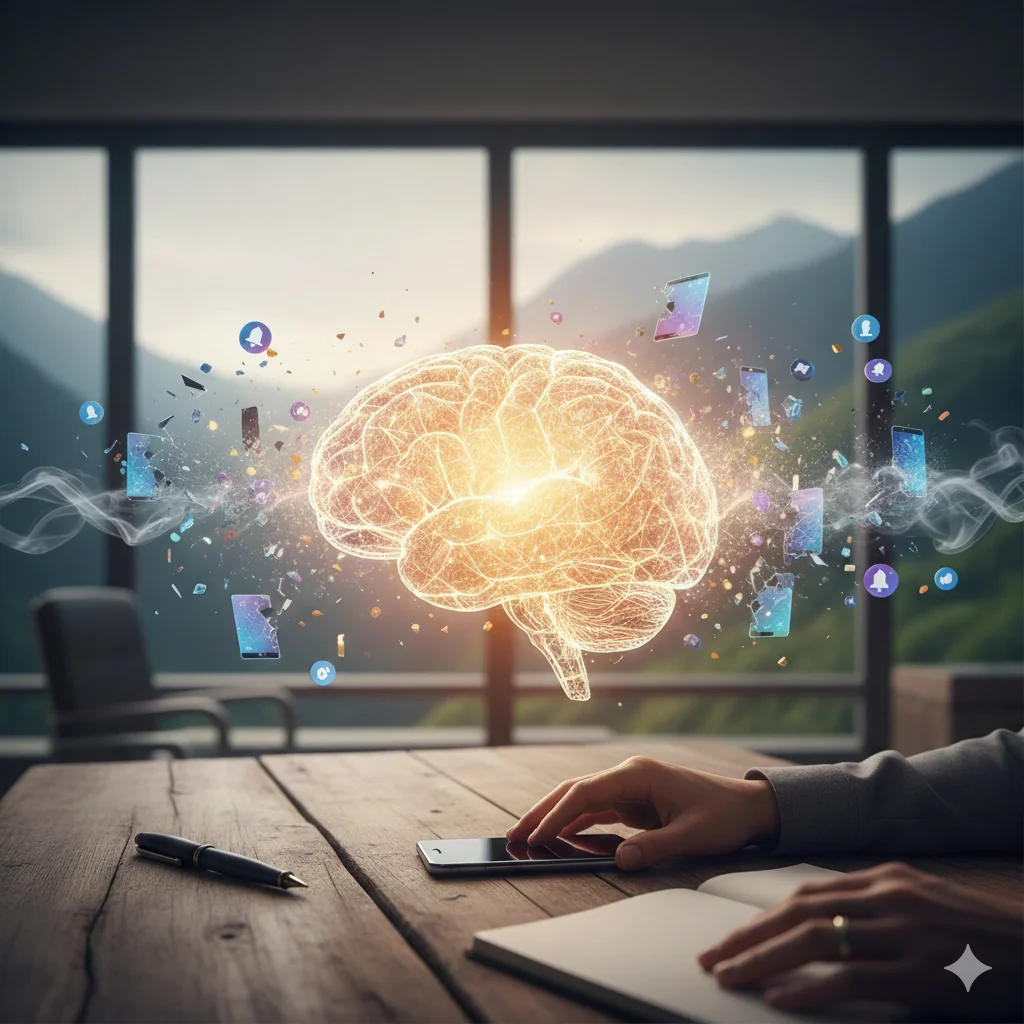
The truth is, we've been sold the idea that being available twenty-four hours a day is a must for success. In the world of marketing and digital business, it feels like if you don't answer a message within three minutes, you're missing a golden opportunity. Yet the reality is far harsher: the inability to disconnect from your phone is eroding our creative capacity and, by extension, the profitability of our business. The human brain isn't an infinite processing machine; it needs silence to come up with the ideas that really move the needle.
These days, the simple act of leaving the device in another room feels like an act of rebellion. But if we look at it coldly, this dependence is no accident. Behind every notification there's an engineering strategy designed to hold us captive. Learning to set limits is not just a mental-health tip; it's a smart business decision. Whoever masters their attention masters their market. And the truth is, nobody takes better decisions under a constant barrage of blue lights and alert sounds.

The impact of "always on" on productivity
When we talk about the need to disconnect from your phone, we're talking about regaining control over your working day. Technology should be an employee at your service, not a boss telling you what to do every second.
Attention fragmentation: Every time you look at your phone, it takes an average of twenty minutes to get back to your previous level of focus. Multiply that by fifty times a day and you'll see where your profit is going.
Willpower depletion: Resisting the urge to check your phone burns mental energy you should be spending closing sales or designing your next content strategy.
Loss of depth: The great marketing solutions don't appear while scrolling, but in moments of boredom and complete disconnection.
Business strategies for effective disconnection
Many entrepreneurs are afraid that, by disconnecting from their phone, their community or customers will feel abandoned. The key to avoiding that lies in automation technology and clear communication. A solid business is one that can run without its owner being a slave to WhatsApp notifications.
Automation and expectation management
Trust-based marketing relies on delivering what you promise. If you educate your customers about your hours, they will respect your time. The strategy is simple: be invisible so you can be more effective when present.
Smart auto-replies: Use tools that announce your response times. This reduces customer anxiety and lets you disconnect from your phone with a clear conscience.
Content scheduling: Thanks to today's technology, you can stay present on social media all weekend while you are physically in the mountains. Marketing keeps working, you don't.
Technical delegation: If your business has grown enough, having someone filter the urgent stuff is the best investment you can make for your mental health.
The marketing of exclusivity and presence
There is incalculable value in being a professional who isn't always available. Scarcity raises perceived value. In your personal-branding strategy, showing that you value your personal time positions you as a high-end professional who controls their life and their business.
The brain in airplane mode: the benefits of pausing
If we want to understand why it's so vital to disconnect from your phone, we need to look at neuroscience applied to performance. When we switch off digital noise, the brain activates what's known as the "default mode network", which is precisely where the magic of innovation happens.

Recovering the ability to wonder
The truth is that technology has stolen our "doing nothing" moments. Those minutes in the supermarket queue or while waiting for a coffee are now filled with junk content. By disconnecting from your phone, we let our mind process the day's information and turn it into strategic wisdom for our professional future.
Improved sleep quality: Blue light interferes with melatonin. Real rest translates into a more focused, less reactive leader.
Lower cortisol: Fewer notifications mean less stress. A business run from calm is always more sustainable than one run from constant urgency.
Stronger real-world bonds: In relationship marketing, nothing beats a face-to-face conversation with no phone on the table. Total presence is the new luxury.
Practical steps for a sustainable digital detox
It's not about throwing your smartphone in the bin, but about renegotiating your contract with it. The strategy to disconnect from your phone must be gradual and tailored to your lifestyle and your business needs.
Notification audit: Only keep on those that bring you money or safety. The rest are distractions that cannibalise your time.
Tech-free zones: The bedroom and the dining table must be sacred. This is a golden rule for both your personal life and a healthy business mindset.
"Do Not Disturb" as the standard: Set up automatic schedules during which the phone becomes a simple brick. Your communication strategy must adapt to you, not the other way round.
Technology in service of freedom
Ironically, there are apps designed specifically to help you disconnect from your phone. From app blockers to timers that reward your focus. Using technology to beat technology itself is a masterstroke of personal marketing.
Conclusion: The future belongs to the disconnected
To wrap up, we need to understand that the ability to disconnect from your phone will be the most important competitive edge of the next decade. In a world where everyone is distracted, the professional who manages four straight hours of focus is a giant among dwarves. Your business isn't going to collapse because you take a screen-free Sunday; on the contrary, that rest is very likely what gives you the vision to double your results next month.
Digital marketing has handed us amazing tools, but we mustn't forget that we are the drivers, not the passengers. Reclaiming control is a process that takes discipline, but the gains in clarity, creativity and peace of mind are incalculable. It's time to switch off the screen to switch our vision of the future back on. At the end of the day, the most interesting life always happens outside the five-inch frame of our phone.