
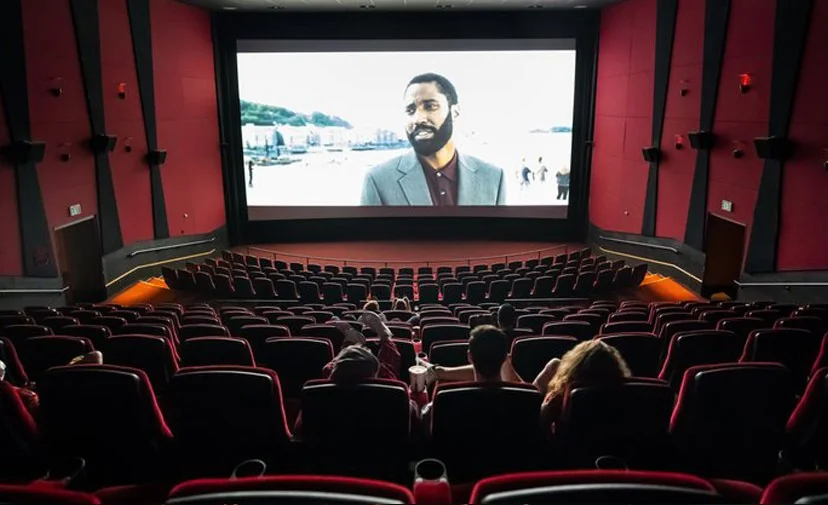
The truth is that we're witnessing a historic paradigm shift redefining the foundations of the global entertainment industry. For nearly a century, cinema was the undisputed epicentre of the leisure business, a pilgrimage site where narrative and community met under a projector's beam of light. However, as we cross into 2026, the balance has tipped definitively and perhaps irreversibly towards the intimacy of home. The rise of streaming television services isn't only a matter of technical convenience; it's a mass-consumption strategy based on immediacy, algorithmic personalisation and the cost efficiency that has transformed the act of going to the cinema: from a democratic social habit it has become a luxury, almost nostalgic, event.
Domestic-consumption technology has reached a maturity where the living room competes with — and often surpasses — the technical offer of many commercial screens. With the democratisation of large-format OLED panels, Dolby Atmos spatial sound systems and 8K resolution that delivers stunning sharpness, the "added value" once offered only by the big screen has thinned out for the average viewer. The reality is that, unless it's a visual experience impossible to contain in a home setting, the user prefers the sovereignty granted by streaming: the flexibility to pause to take a call, replay a complex scene or simply consume content without the extra costs of travel, parking and food that today inflate the price of a traditional cinema outing.
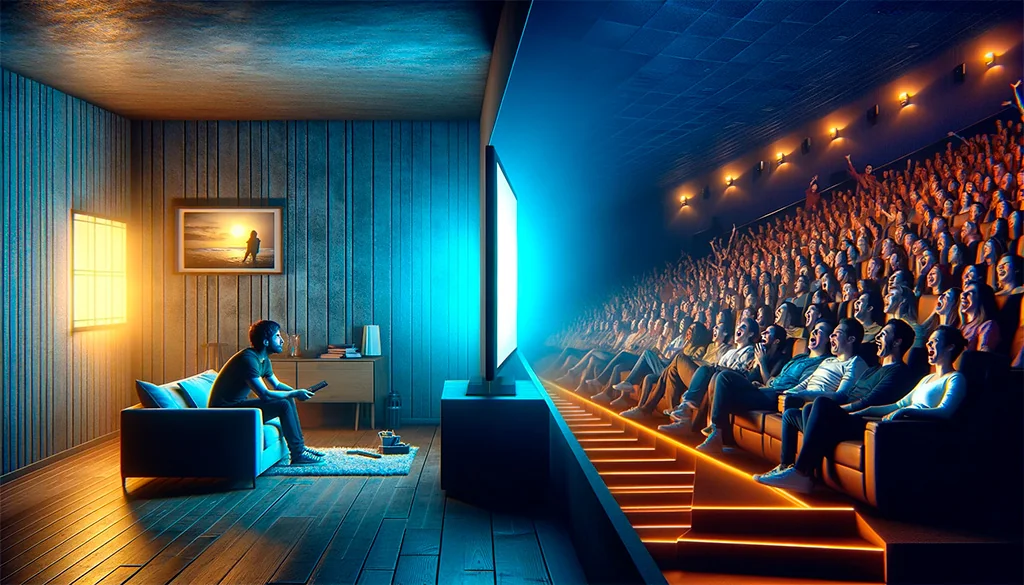
Key factors behind the 2026 attendance drop
Radical window shortening: Films land on digital platforms barely a few weeks after release, psychologically incentivising the viewer to wait briefly to watch it on their subscription.
Saturation and franchise fatigue: After years of dominance, the public has clearly shown signs of exhaustion with endless sequels and creatively risk-free remakes.
Opportunity cost and family economics: In a persistent inflation context, paying a monthly subscription gives thousands of hours of varied content for the price of a single ticket and a popcorn pack.
The year of impossible budgets: The 2025 flops
The 2025 cinematic cycle will be remembered as the moment when major Hollywood studios crashed head-on into the wall of unsustainable profitability. The strategy of pumping astronomical budgets, often above $200 million, hoping for massive returns above $1 billion, has systematically failed. These box-office "flops" not only represent accounting losses but compromise the majors' financial structure and production capacity for the coming years.
Below we analyse the most striking failures where takings didn't even cover the basic costs of production and aggressive global marketing:
1. Snow White (Disney)
This is, without doubt, the most dramatic and analysed case of the year. After a troubled production, social-media controversies and expensive reshoots, the budget shot up to an estimated $270–300 million. However, the public's reception was icy, taking in barely $205 million worldwide. Considering that a blockbuster of this scale needs to triple its production cost to break even (due to revenue split with exhibitors), total estimated losses exceed $400 million.
2. Mickey 17 (Warner Bros.)
Despite carrying the seal of Oscar-winning director Bong Joon-ho and the media pull of Robert Pattinson, this ambitious sci-fi bet failed to break out of the niche audience. With a budget near $150 million, its global takings stalled at around $130 million. Warner tried to mitigate the damage with a surrender strategy: it brought forward the digital release to just 18 days after the theatrical debut, prioritising its streaming ecosystem over the agonising physical box office.
3. Mission Impossible: The Final Reckoning (Paramount)
Even one of the most solid and respected franchises in recent history has felt the lash of this crisis. Tom Cruise's latest odyssey reached a production cost of $400 million, in part due to the complexity of its real action scenes. Although it took in $595 million, a figure that would have been considered a hit in the last decade, the profit margins in cinemas are nil after deducting massive advertising spend and the exhibitors' cut.
4. Captain America: Brave New World (Marvel Studios)
The once-invincible Marvel cinematic universe continues its downward trend. With a production cost of $180 million, its takings landed at $400 million. Although on paper that looks like a positive figure, it fell below the real profitability threshold set at $425 million, confirming that Marvel marketing no longer guarantees success through inertia in a saturated market.

The technology and marketing of Connected TV
While physical theatres struggle to fill their seats, digital platforms are leveraging Connected TV (CTV) technology to absorb the advertising investment that used to flow towards other media. The current strategy of giants like Netflix or Disney+ has evolved: it's no longer just about capturing new subscribers, but maximising dwell time through precise recommendation algorithms and segmented advertising plans.
The reality of the business has mutated towards data efficiency. Today it's much more profitable for a studio to have a captive user in front of their Smart TV — where every click, pause and preference can be monitored to sell high-precision advertising — than to sell an anonymous physical ticket through a third party. By the end of this year, advertising spend on streaming platforms is expected to grow 12.1%, cannibalising the budget traditionally aimed at conventional TV and at supporting big theatrical releases.
Conclusion: The end of the era of inflated blockbusters and the rebirth of experience
The lesson 2025 and the start of 2026 leave us is as clear as it is painful for the traditional industry: the "inflated blockbuster" model is mortally wounded. Today's audiences are smarter and more demanding than ever; they are no longer willing to make the logistical and financial effort to go to the cinema to consume generic content or repetitive formulas they know will be available on their TV in less than a month. The Hollywood studios' strategy must do a 180-degree turn: the era of spending $300 million on a film just to look "like another one of many" is over due to pure financial unviability.
However, this doesn't necessarily mean the death of cinema, but rather its radical transformation. We are entering a coexistence model where cinema becomes a space for artisanal art, specialised festivals and major visual "events" that are impossible to replicate outside a twenty-metre screen with laser technology. Meanwhile, streaming has taken over as the new mainstream television, where the daily conversation lives. Technology has handed us the absolute power of the remote, and the data suggests the viewer has found a comfort on the sofa that the box office will hardly be able to recover if it doesn't offer something genuinely extraordinary. Cinema is no longer the default destination; it's now a prize films have to earn through originality and creative risk.